|
Morning Oregonian
Portland, Oregon, Friday May 3, 1901 HISTORIC CHAMPOEG ---------------------- Organizers of Provisional Government Honored ---------------------- STATE MONUMENT UNVEILED ---------------------- F. X. Matthieu, Sole Survivor of the 52 at the Meeting of 1843, Unwound the American Flag From the Shaft ---------------------- CHAMPOEG, Oregon, May 2 - Three thousand people witnessed the unveiling this afternoon of the granite monument erected by the state in honor of the 52 men who organized the Provincial Government of Oregon at Champoeg, on May 2, 1843. Francis Xavier Matthieu of Butteville, the sole surviving member of the heroic band whose patriotism assured Oregon to the sovereignty of the United States, unwound the American flag from the shaft at 1:02 PM, just as a gleam of sunlight shot through a rift in the clouds and added the blessing of heaven to the impressiveness of the scene. 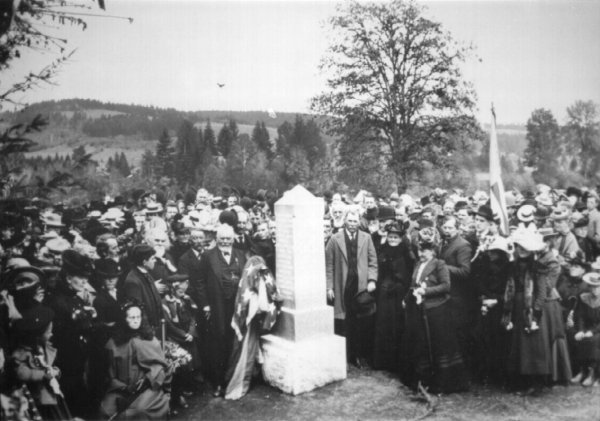
Encircling the identical spot in the field where 58 years ago the cautious Le Breton told the daring Gray that the defenders of American title might risk a division, where the handy mountaineer Meek commanded all who were in favor of organization to follow him. Present were men and women, whose memories and deeds linked the Oregon which is passing with the Oregon that is. A grand- daughter of Dr. John McLaughlin, for many years the chief factor of the Hudson's Bay Company, when the authority of Great Britain was supreme in the region west of the Rocky Mountains, sat in the speakers stand. Descendants of six of the organizers besides Mr. Matthieu were among the spectators. The Matthieu family had eleven representatives - the father and 10 children. Mr. Matthieu is the father of 15 children, of whom five have died. He has 34 grandchildren and two great-grandchildren. Mr. Matthieu and descendants are 52 - exactly the number who voted May 2, 1843, to organize the Provisional Government. As the flag fell from the monument and as the aged survivor of the immortal 52 stood with it folded in his arms, his head bared, the thoughts of every person present instinctively, went back to the May day 58 years ago, when the British settlers defeated in the division by the Americans, retired to a corner of the field and then mounted their horses and rode away. People began arriving from all parts of Marion County with the break of day. Three hundred teams were hitched in the groves around historic Champoeg. The oldest carriage was driven from Barlow by William Barlow. Governor Abernethy sold the conveyance to Mr. Barlow in 1854. 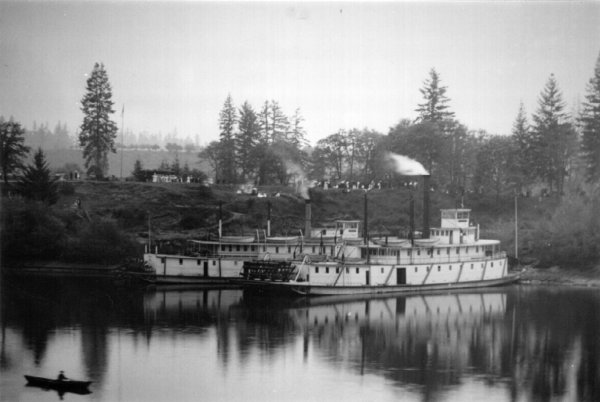
The Altona arrived shortly after 11 o'clock with 150 people from Portland and points along the river. Among them were Sol Blumauer and Fred Saylor, grand president and grand secretary, respectively, of the Native Sons; Mrs. V. W. Palmer, grand secretary of the Native Daughters; T. A. Wood, grand commander of the Indian War Veterans; J. T. Apperson, president of the Oregon Pioneer Association; Judge Alfred F. Sears, Judge John B. Cleland, Senator Alexander Sweek, A. H. Breyman, Hon Otto Schumann, who designed the monument, and many others whose names are mentioned in other connections elsewhere. Reminiscences of the Pioneers. The Portland contingent had a pleasant trip. Despite the sharp wind that swept down the river, they gathered on deck to discuss the historic, associations of Milwaukee, Oregon City, Canemah and other places as the steamer passed them. At New Era the California Overland on the Southern Pacific whistled a "hip, hip, hurrrah, tiger" as it whirled around the big bend in the Willamette. The contrast between the vestibuled Pullman of the overland and the stage or mule of the early days, caused many a pioneer to note the difference in traveling between the old time and the new. Silas B. Smith recalled the voyages by canoe between Astoria and the Upper Willamette. "Jim" MaCown, the veteran proof reader of The Oregonian, was reminded that the overland train was passing over the very route on which he carried the mail between New Era and Oregon City in 1758. "Yes." he said reflectively, "I received $1.50 a trip, and was tickled to death to get a chance to visit Oregon City and be paid for the pleasure, too." R. S. MacEwan, 87 years old, but with the eyesight of a boy of 20, read The Oregonian without spectacles. He was the first County Clerk of Clatsop County, when part of what is now Southwestern Washington carried on its litigation at Astoria, and thinks he has the honor of being the first one appointed to the office of County Clerk under the Territorial Government of Oregon. He opened his records at Astoria September 2, 1850. The appointment was made by Judge William Strong, on board the American sloop-of-war Falmouth. Mr. MacEwan served Clatsop County for four years as Clerk and was afterwards for 14 consecutive years Recorder of the town of Clatsop. Many a call was made upon Silos B. Smith for a story of pioneer times. Mr. Smith's father was Solomon H, Smith, one of the organizers of the Provisional Government, a companion of Captain Nathaniel Wyeth in the expedition of 1832, a New Hampshire man by birth, and a second or third cousin of Horace Greeley. Silas Smith's mother was Princess Celiast, second daughter of Cobaway, who was chief of the Clatsop Indians 103 years ago, and who entertained Lewis and Clark when they ended their exploring expedition at the Pacific Ocean in 1806. Solomon H. Smith and Calvin Tibbetts, both organizers of the Provisional Government, moved from the Willamette Valley to Clatsop County in 1840. Mr. Smith was asked, to suggest how it was his father and Mr. Tibbetts happened to be at Champoeg, May 2, 1843, at the very time, their votes were needed by the American settlers. The trip is about 145 miles by water, which was no easy thing 58 years ago. Mr. Smith said it was possible that his father and Tibbetts, were in the valley buying cattle, but it was more likely that they had been sounded by the Americans, and having been found favorable to organization, were quietly notified to be on hand. This explanation of Mr. Smith's, if it shall hold good in the light of facts, which may be brought out in discussion of it, shows how carefully the men of the wolf meetings laid their plans to knock the props from under Great Britain's claim to Oregon. Welcome to Champoeg. The Portland boat was met at the landing by Matthieu's Cabin of Native Sons and its band. The Union Cornet Band led by James Parrott, a pioneer of 1852 was also on hand. The members of this band are: Solo B flat cornet, James Parrot; solo B flat cornet, M. C. McKern; solo B flat cornet, R. V. Pratt; first cornet, W. F. Jones; solo alto, T. H. Parrish; first alto S. S. Parrot; second alto A. C. Bristow; baritone, S. Parrish; first tenor, Richard Parrot; second tenor A. C. Parrot; E flat clarionet, Granville Everest; E flat bass, J. A. Parrot; B flat base R. O. Bristow; base drum, Ellis Parrot; snare drum, George Smith. Mr. Parrot, the leader, was a member of what was probably the first band in Oregon, which was organized by his father, Thomas Parrot, in Chelam Valley, some time in the year 1855. All members of this band are either pioneers, or were born and raised within a radius of five miles of Champoeg. As fast as the visitors left the boats they sought out Mr. Matthieu, to have a word with him or shake him by the hand. One who asked him what kind of weather Champoeg had May 2 1843, was told, "Just as fine as today, except that there was no music." To another Mr. Matthieu said it was a busy time, as the organizers of Government went without dinner. Champoeg - The marshal of the day Benjamin M. Smith, with James E. Eldriedge and Elwood Abernethy assisting. Between 11 and 12 lunch was served to the pioneers. To the citizens of Champoeg and vicinity much credit is due for the complete arrangements made for the comfort of all attending. The lunch and decorations were prepared by Mrs. Mattie E. Eldriedge, Mrs. W. T. Colman, Mrs. Emma Wengenroth, Miss Rosa Scollard, Misses M. A. and R. A. Smith, Miss Mary McCann, Mrs. J. E. Smith, Mrs. B. M. Smith, Mrs. A. Jette, Miss Lillan Jette, and Miss Azilda Jette, all native daughters except Mrs. Wengenroth. The flagpole, 80 feet high, was donated by Mr. F. E. Osborne, a native son of 1861. Other gentlemen assisting in various departments of the work were: Henry Zorn, George G. Eberhard, Benjamin M. Smith, James E. Smith, James E. Eldriedge, John Scollard (an old veteran of the Yakima war), Elwood Abernethy, Guy V. Abernethy, J. P. Eberhard, Albert Eberhard, Henry Austin, Adolph Jette, Jr., Henry Goodell, Jack Tremewan, Frank Scollard. Why McLaughlin Selected Champoeg From time immemorial, according to information obtainable from Indians and through the early settlers of French Prairie, the sandy tract lying along, the eastern bank of the Willamette - known among the Indians as "po-lal-la il-la-hee", on account of the sandy nature of the soil - upon which the village of Champoeg was built, was the site of a great Indian village or camp - hence - "Champo-ick", or "place of the camp" or, to use the French word, "Campment du Sable." This fact caused Dr. John McLaughlin chief factor of the company at Vancouver, to select Champoeg as a trading point, and hence the erection of the store about 1830, at which the famous meeting of May 2, 1843 was called. It is difficult to state who was the first person to have charge of this store, but it is believed that it was a confidential clerk of Dr. McLaughlin by the name of Angus MacDonald; at least, he was in charge in the year 1842, when Mr. Matthieu appeared on the scene, and remained for a number of years afterwards. He was succeeded by a Mr. Grahame, who remained in charge, closing up the company's business, until the flood of December 1860. It would be a matter of great interest had, there been a chronicler present at the meeting of 58 years ago to describe carefully the manner of dress of those who were here assembled, in order to contrast it with the style in vogue at this time. 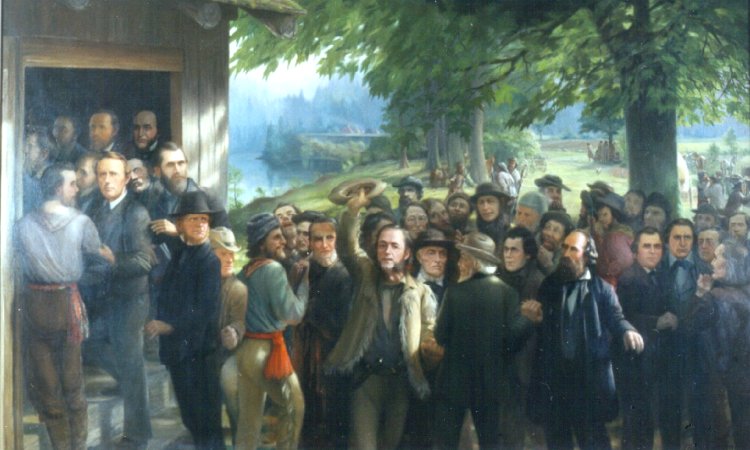
Suffice it to say, however, it is known that there was a great mixture. Each person was a law to himself, as to the style of his dress. No white-shirted persons - "biled rags", in the vernacular of the time - were present, save the few, missionaries, and of these two ministers only. The starched shirt was the badge of distinction. The French settlers were clothed in Hudson's Bay Company stuffs, calico shirts, brown corduroy and moleskin pants, with moccasins on their feet, with soft, broad-brimmed, black felt hats. The mountain men - Americans - were mainly dressed in buckskin suits, with ample fringes on the pants, and the same soft hats. The American settlers were clad in the residue of the garments they had left over from crossing the plains - altogether it was a motley crowd, a crowd which, if its personnel could be given with reasonable accuracy, and the full significance of what has grown out of that gathering of incongruous elements adequately portrayed, would give a subject for a great historical painting. Mr. Matthieu Honorary President. At 12:20, Judge C. B. Bellinger, vice-president of the Oregon Historical Society, called the meeting to order. F. X. Matthieu was elected honorary president and Governor T. T. Geer, active president. Behind Mr. Matthieu was seated Mrs. M. L, Myrick, of Portland, granddaughter of Dr. John McLoughlin, and behind Governor Geer sat Louis Le Bonte, the oldest male native of Oregon of French-Canadian and Indian parentage. Mr. Le Bente was born in Asortia in 1818. Others on the platform were: John Minto, of Salem; William M, Case, of Champoeg; G. L. Rowland, of North Yamhill; William Barlow, of Barlow, son of the owner of the old immigrant road; Mrs. Wiley Edwards, of Newberg; J. H. McMillen, of Portland; Mrs. Harriet K. McArthur, of Portland, daughter of ex-Senator Nesmith; Asahel Bush, of Salem; Secretary of State Dunbur; State Treasurer Moore; R. S. MacEwan, of Astoria; Mrs. H. W. Scott, of Portland; Mrs. C. A. Coburn, of Portland; Rev. and Mrs. H. K. Hines; Rev. P. S. Knight; W. S. Duniway, of Portland; John Hoefer of Champoeg, one of the donors of the site for the monument; Mrs. M. A. Kenady, of Woodburn; Mrs. H. B. Nicholas, of Portland; Mrs. E. Eberhard, of Butteville; Mrs, M. C. Howard, of Newberg; J. S. Vaugan, of ButteviIle; Mrs. George Myers, of Newberg; Mrs. Susan D. Meldrum, of Oregon City, and Marianne Hunsaker D'Arcy, of Portland. Relatives of the organizers of the provisional Government who were, present were: Mrs. J. K. Gill, of Portland, daughter of Dr. W. H. Willson; Captain J. H. D. Gray of Astoria, son of W. H. Gray; Rev. H. K, Hines, of Portland, brother of Rev. Gustave Hines; Mrs. J. H. Albert, of Salem, daughter of Joseph Holman; Fred A. Crawford, of Dayton, son of Medorem Crawford; Mrs. E. W. Cornell, of Portland, daughter of J. R. Robb. The children of Mr. Matthieu who were present were: Mrs. Minnie Geer, Mrs. Clara Ouimette, Mrs. Rose Bergevin, Mrs. Arsena Burton, Mary, Charles, Albert, Ernest, John and Lester Matthieu. Among the spectators were noticed the following who came to Oregon in the period of the Provisional Government or were born here: 1818 - Louis Le Bonte, St. Paul. 1838 - John B. Bourjan. 1889 - J. H. D. Gray, of Astoria; Silas H. Smith, Warrenton. 1840 - F. Gegoire, Gervias. 1844 - J. C. Nelson, Newberg; Joshua McDaniel, Rickreall. 1845 - Mrs. C. M. Cartwright, Portland; Mrs. S. M. McCown, Oregon City; B. F. Hall, Woodburn; R. F. Cooley, Woodburn; H. Terwilliger, Portland; C. C. Bozarth, Portland; W. Carey Johnson, Oregon City; Mrs. Susan D. Meldrum, Oregon City. 1846 - Mrs. Lydia Wood, Woodburn; Mrs. W. F. Gilkey, Dayton; Mrs. R. S. MacEwan, Astoria; W. R. Dunbar, Vancouver, Wash; Marrianne Hansaker D'Arcy, Portland; Mrs. Prudence Holston, Portland. 1847 - W. M. Merchant, North Yamhill; W. T. Legg, Portland; J. T. Apperson, Oregon City; Anson Cone, Butteville; W. J. Jones, Newberg; Mrs. R. H. Hopkins, Butteville; G. W. Dimmick, R. V. Short, Portland; David Caufield; Judge Charles B. Bellinger, Portland. 1848 - John W. Minto, Portland; J. D. Lee, Salem. 1849 - Judge R. P. Boise, Salem; H. A. Johnson, Salem. Invocation by Rev. P. S. Knight The ceremonies opened with an invocation by Rev. P. S. Knight, of Salem, who said: Almighty Father: We believe in thee as the creator of all things, as the provider of all wants, and as the controlling and directing power in the affairs of men. We are sure that our fathers were guided to these shores and in the creation of the institutions under which we live. We are sure that their children were by thy love and wisdom guided from the eastern to the western shores of this continent. As we commerate some of their labors today, we would not forget to render thanks to thee for the goodly lives they lived, for the self-sacrifice and devotion to high duty that moved them, and for the success they met in laying here the foundations of free institutions. As their successors, we ask for divine guidance and blessing, that, following in their steps, we may prove wise and faithful in carrying on the work they so nobly began. Not only in the monument we unveil today, but in the way we serve our country, the world, and thee, may we help them to speak to coming generations. And to thy name shall all praise be given now and forever, Amem. George H. Himes, assistant secretary of the Oregon Historical Society, sprung a little suprise that struck everyone as the right thing. He paid a tribute to Mr. Matthieu's honored connection with the history of Oregon, concluding by presenting him, in the name of the Oregon Historical Society, with a handsome badge. Governor Geer pinned the badge on Mr. Matthieus breast and three cheers were given for Mr. Matthieu and three more for the State of Oregon. The badge is in silk, in red, white and blue colors. At the top, in a rosette, is the seal of the Provisional Government, and in the center, under the words, "Pioneer of 1842", is the present seal of the State of Oregon. In gold letters is the inscription, "Only survivor of the 52 persons who voted for the organization of the first civil government at Champoeg, May 2, 1843, known in history as the Provision Government". Governor Geer's Speech Incidents of the Times When the Government was Formed. Governor Geer then delivered the following introductory address, which was also a history of the acts of the Provisional Government: "The great historic event whose 58th anniversary we meet on this occasion to commemorate was of greater importance and has been more far-reaching in its consequence than could have been supposed by any of those who took part in the proceedings. When upon this exact spot 58 years ago today, Joe Meek, in his impulsively patriotic manner, called for a "division", and taking his stand apart from the others, asked all those who were in favor of an organization to follow him, he could not have forseen, neither could his compatriots, the future great commonwealth to be reared upon an enduring foundation, the corner-stone of which was that day so dramtically provided. But all governments have their beginnings, and where they are not the result of a revolutionary overthrow of some former one, but spring of the necessities of pioneer settlers, they are usually the offspring of an unselfish endeavor and a purpose to protect life, liberty and property impartially and effectually." Romantic Early History. A truth recital of the circumstances surrounding the early occupation and settlement of Oregon reads like a well-prepared romance. The situation was wholly unlike that pertaining to the early occupancy of any portion of our entire country. When the early American immigrants began to come here in considerable numbers, the "Oregon country" was not a part of any nation, but was resting under a not well defined claim of both the United States and of Great Britian. It was indeed an independant community, really owing allegiance to no higher power, and was, in fact, for some years after its inception a pure Democracy. The early settlers referred to The United States as a foreign country. The early archives are full of such references and as late as the 17th of December, 1847, the Legislature passed an act appropriating $500 dollars "to defray expenses of J. E. Meek as special messenger to the United States." It is both interesting and profitable to note that the early efforts toward establishing a civil government were marked by that simplicity and sturdy economy that characterized the pioneers in their daily lives. It was the ground work for that predominating feature in our present State Constitution, inserted by the successors of these men in a later decade, which limits the number of state officers performing the principle duties of the state government below that prevailing in any other state in the union. "4. That a bounty of 50 cents be paid for the destruction of a small wolf; $3 for a large wolf, $1.50 for a lynx, $2 for a bear, and $5 for a panther. "5. That no bounty be paid unless the individual claiming said bounty gives satisfactory evidence, or by presenting the skin of the head, with the ears of all animals for which he claims a bounty. "6. That the committee and treasurer form a board of advice to call public meetings, whenever they may deem expedient, to promote and encourage all persons to use their vigilance in destroying, all the animals named in the 4th resolution. "7. That the bounties named in the 4th resolution be limited to whites and their descendants. On motion, it was resolved, that no one receive a bounty (except Indians) unless he pays a subscription of $5. "It was moved and seconded that the Indians receive one-half as much as the whites. "It was moved and seconded that all claims for bounties be presented within 10 days from the time of becoming entitled to said bounties, and if there should be any doubts the individual claiming the bounty shall give his oath to the various circumstances; which was carried." In the meantime; however, it was becoming apparent to the settlers of the Willamette Valley that the protection of their own lives and rights, as well as their herds, could not be longer safely postponed. There can be no doubt that the Champoeg meeting had this end chiefly in view, although the intention had evidently been largely confined to the knowledge of those who sympathized with an American Government. Ewing Young's Property An event which emphasized this necessity was the death of Ewing Young on February 15, 1841. Ewing Young was the wealthiest American citizen in the country, and, leaving no will or heirs, as far as was known, and there being no probate officer, the distribution of his property was a question of great importance. His property eventually went to the territorial government, but it required some years to effect this result. On December 11, 1845, Mr. Garrison presented a petition to the Provisional Legislature, "from Daniel Waldo and Thomas Jeffries, in relation to the estate of Ewing Young." Reference is made to the same matter in the Oregon Archives on December 17, 1845, on December 4, 1846, and again on the 8th. The matter was finally disposed of by an act passed December 24, 1846, and which reads as follows: "Section 1 - Be it enacted by the Legislative committee of Oregon; that the executive power shall appoint an administrator to close up and collect the debts due the estate Ewing Young, deceased, and that the administrator shall proceed as soon as possible to wind up the business of said estate. "Section 2 - That the executive power shall cause to be let out to the lowest bidder the building of a substantial log jail at Oregon City, to be finished in such time and manner as they may think proper, and shall take such bond and security as may be sufficient to secure its completion. Section: 3 - That said administrator shall pay all moneys collected by him belonging to the estate of said Young, deceased, to the Treasurer of Oregon, whose duty it shall, be to give the said administrator a receipt for the same. Section: 4 - That the sum of fifteen hundred dollars be and the same is hereby appropriated for the building of said jail, to be paid out of the first moneys received by the said administrator of said estate, and in the event there is not so much received, then the balance to be paid out of any money in the treasury not otherwise appropriated. Section 5 - That the faith of this government is hereby pledged for the payment of all moneys hereafter received from the administrator of the estate of said Young, whenever the same shall be lawfully claimed, and said claim established by heirs or creditors of said Young. Section 6 - That the executive power shall be authorized to receive a lot donated by John McLoughlin for the purpose of erecting said jail, which lot shall be conveyed to Oregon agreeably to a communication of said John McLoughlin addressed to a committee of this House appointed to wait upon him. Section 7 - That said jail shall be used for the imprisonment of all criminals in Oregon. "Passed December 24, 1844 Signed M. M. McCarver Speaker." The Intention of our sturdy fathers to do absolutely the right thing at all times is well illustrated in the 7th section of this act, in its comprehensive provision for, "the imprisonment of all criminals in Oregon", in this proposed jail. Whether the jail was ever built in accordance with the requirements of this act is somewhat doubtful, since it is recorded that on December 13, 1847, three years later, Mr. Nesmith of the committee on judiciary, to whom was referred that portion of the Governor's message relating to the erection of the jail, reported they deemed it in expedient in the, present embarrassed condition of finance to incur the expense of a jail." Although the estate of Mr. Young was collected into the treasury it was never regarded as the absolute property of the territory. |