Notes :
(1) At the age of 23 we find Théo Gégoux the exbartender launching out into the art of portrait making. Having returned to Carthage N.Y. he opened a studio, and for nearly four years, continued to study portraiture in crayon, pastel and oil. But a larger field of operation was desirable and he resolved to remove his studio to Watertown, N.Y. Where after two years of close attention to business he had saved enough money to enable him to take a trip to Europe.
The reader must understand that this student had never received any instructions in the art of drawing and painting, and yet, while feasting his eyes on the many great works of art in the Louvre and in the Luxembourg he was inspired to copy some of the Master Pieces, believing that he could acquire knowledge of colors by so doing.
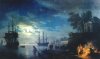 He decided to copy three masterpieces. First, a beautiful sunlight effect that which he found in Jules Breton's, "La Benediction des Blis". The next was a moonlight picture by Joseph Vernet. The third was a lamp light effect by Prud'home, "Clytemnestra and Egistre" her accomplice. Having completed these three paintings which were considered excellent copies he returned to America with them and reopened his studio in Watertown, N.Y. - Theodore Gegoux Autobiography, 1926.
(2) Taking the excursion aboard the popular St. Lawrence, with its great searchlight for evening trips, was considered a "must" on the vacationist's schedule.
 This boat probably comes most readily to the mind of such persons as enjoyed "summering at the river" during those years between 1890 and World War I. Built in Clayton in 1884, she was a steel-plated side-wheeler of 312 tons. Prominently displayed on the wheel housing was the widespread eagle, which with its characteristic whistle, were identifying features. Much has been written in a nostalgic style regarding that so-called Steamboat Era which gradually passed away as the Twentieth Century advanced. - Jefferson County Historical Society, "Bulletin", vol. 25, May 1993, written by Hazel M. McMane, Historian, Alexandria Bay, New York.
(3) Artist Theodore Gegoux of this city, has received notice from John W. Beatty, director of the great art exhibition in the Carnegie Art galleries at Pittsburgh, PA., that his picture entitled "A Young Paganini" has been accepted and given a position as No. 117. The handsome book published by the exhibition gives his name and the title and number of the picture. The work is an evening scene representing a musical student playing the violin by lamplight. The rich colorings and strong contrasts and effects of this kind of work, as well as in more delicate lines, Mr. Gegoux has always been exceedingly successful, and it is no great surprise, though it is a source of much gratification to his many friends and admirers throughout Northern New York, that his work has been so signally honored as to be selected for exhibition from among the many hundreds of pictures which have been offered at Pittsburgh. - Watertown Times, November 1896.
(4) Under the shadows of White Face Mountain, the Ausable River explodes into deep crevices in its 700-foot journey through ancient granite cliffs formed over a billion years ago by the forces of ice, water, and wind. - Roanka Attractions Corp, 1999.
(5) Theodore Gegoux, one of the most gifted portrait and landscape artists this city has ever produced, who mysteriously disappeared two years ago, has been located, it was learned today, alive and in good health at Portland, Oregon, where he is said to have been living since shortly after he left Watertown, and where he is said to be applying himself assiduously to the painting of portraits and landscapes, he having, it is said, painted portraits of several prominent residents of the Oregon city and to have turned out a prodigious amount of landscape work.
Two years ago last month Mr. Gegoux, who had a studio in the Vann Namme building in Public square, started for New York, it was stated, to fulfill a commission for a portrait in oil. From New York it was learned that he went to Cleveland, where he had relatives, and then, it is said, all trace of him was lost. At first, it is said, his family believed he had gone to San Francisco, to attend a big aviation meet, he having become interested in the new science, but later as no news came, it was believed he had met his death somewhere in the West. - Watertown Times, December 1911.
(6) His steamer trunk has a destination of Eugene, Oregon painted on the outside, which would be unlikely for a ship. - Theodore Gegoux III, 1999
(7) The Gleall Castle was built in 1892 and still stands today at 2591 SW Buckingham Terrace. Designed by and built for Charles Henry Piggot, who came to Portland in about 1877. Charles H. Piggot was a President of the Pioneer Wood Company in 1890 and he established the brickyard, which became the Union Brick Company. - Oregon Historical Society Library, "Historic Resource Inventory - City of Portland", 1981.
(8) The Portland Rose has as a background the view from the hillside near Gleall Castle. The riverfront of Portland, circa 1911, can be seen in the right center of the painting and Mount Hood is distinguishable in the top right.
 We do not know the woman depicted here. Roses were a popular theme with Gégoux during this period, and they remain a passion of Portland residents to this day. The Portland Rose is a major transitional piece, which Gégoux had finished by the time of his son Frank's visit to Gleall Castle in June of 1911. Frank's photo album clearly shows the castle and a completed Portland Rose at this time. In a letter written on July 1925 from Highland Park, California, Gegoux refers to his painting "Miss Rose Portland". The painting was never signed. The Portland Rose is 77 inches by 43 inches in size. It is oil painted on canvas. The painting remained rolled in storage for 50 years. Then in 1977 at Austin, Texas, a new canvas backing was applied with bee's wax and the painting was restretched. More recently the Portland Rose was completely restored at the Lucas Conservation Laboratory, in 1998. The painting was relined, cleaned, sealed, and retouched. - Theodore Gegoux III, 1999.
(9) A photograph of "Still-Life with Jelly Jar" 1911, as available in "Oregon Painters, the first hundred years (1859-1959)", Ginny Allen & Jody Klevit, 1999.
(10) At some time in late 1912 or early 1913, Théo moved to Santa Monica, California and set up a studio to finish painting the "Early Mayors of Portland" series. This series is 29 identical canvases, which were used to paint the portraits, in oil, of the first mayors of Portland City. Théo was still working on this series while in Santa Monica. It is believed that he finished painting this series in late 1913. The series was done mostly from photographs, which were provided by George Himes of the Oregon Historical Society. - Letters, Himes - Gegoux, 1913.
(11) This location was near the site of the "Long Wharf" which was a 4720 foot long pier into the Pacific Ocean which served as a deep water port in those days. A double set of train tracks ran along this wharf out to where ocean going vessels could off load cargo, mostly coal from Vancouver Island. - "Santa Monica Bay" - Fred Baston, 1974.
(12) During the 1979 visit, I made notes on the painting in Mrs. Eldriedge's home titled "Topanga" Canyon. It was an oil on canvas signed in the lower left corner, "T. Gegoux, 1914".
 The sight measurements of the canvas, that is to say not including the three-inch wide gilded green cavetto molding that framed the picture, were 17 1/2" x 29". In giving measurements, I recite height first, width last. I described this picture as including a barren hill and a lake, pond, or river. There were some trees in the picture, however, and one of them was a flowering variety. There was a low bridge with wooden railings in the picture, and centered in the foreground, as a traditional repoussoir device, was a snag on the near bank. Mrs. Eldriedge said she understood that Gegoux had painted it in the mornings at about 7:00 am in order to get the effect of the fog rising from the water. I found that the canyon is above Malibu Beach northwest of Los Angeles. There were no buildings in the canyon at the time of the representation. Now, of course, the area is heavily built up. Mrs. Eldriedge said this was one example of the artist's intense interest in capturing effects of light and atmosphere. Théo gave this painting to the Eldriedge family for their kindnesses to him over the years. - Elisabeth Walton Potter - 1979.
(13) Guy V. Abernethy, who was in town Monday, said in a recent visit he made to Champoeg, he found an artist, Theodore Gegoux, a French Canadian, from New York, at work in the old building at one time occupied by the Adolph Jette saloon, engaged in painting a picture on canvas of the scene of May 2, 1843, when Joe Meek made his now famous call for those who favored "a divide" to step over the line.
The canvas is some seven feet by fourteen, and Mr. Abernethy says the painting is apparently going to be a fine piece of work. The artist told him that George H. Himes, of the Oregon Historical Society, was giving him valuable assistance in order that it may be historically correct. The river and plot of ground where the meeting was held is shown, and of course Meek is the central figure, as with raised hand, makes the call for the "divide". The artist says that when the painting is completed he will consider nothing less than $10,000 for it. Mr. Abernethy says that with one of the old saloon buildings of Champoeg being used by a famous artist and the other by a religious sect for holding divine services, time works some changes in the historic old town. - Newspaper Article, believed to be the Oregonian, circa 1917.
(14) Théo came to Oregon because he felt there was material for a great canvas here. He found it in the historic gathering at Champoeg, where, on May 2, 1843, Oregon was given to the Union by a narrow vote. In that event, he thought he saw something very close to the heart of Oregon and that which, once painted, would be treasured by the state. The data was difficult to gather. It was a big task. Of the 52 pioneers who voted to swing their homes under the American flag, but one was living. Even he is dead now. And of many of the others all trace had disappeared. But he found pictures of close to 28 and rounded out the number with minute descriptions of the remainder. He had a problem. He wanted to put down the very spirit of that tumultuous meeting in the warehouse near where the Pioneer Memorial now stands. But he didn't have all the faces. But he had read the history closely and he recalled that when the vote of "ayes" and "nays" had failed to settle the matter, Joe Meek strode out into the air and called the others after him. And this movement he decided to paint, the exterior of the warehouse, the open door, Joe Meek, just out, and calling upon his fellows, and the others pouring forth at his call. - Oregonian - Jay Allen, May 1923.
(15) At some point during the spring of 1918, Gegoux's studio, in an old house, was gutted by fire, destroying nearly all of the contents. It is a miracle that the Jette family was able to save the great painting. Gegoux lost almost all of his supplies and all of the pictures of the founders, on loan from the historical society, were all burned. The Jette's were able to save several works of art, which without their courageous effort, would have perished in this fire. Suffice it to say that this was a tragedy for Théo, although the pain was less owing to the great canvas having been saved by Mr. Jette. - Vernon Jette, 2000.
(16) I had a call from two Catholic priests a few days ago, Rev. W. A. Daly and Rev. Franois R. Black, and they sharply
 criticized your great painting .. or, rather the description of it, as noted in the circular, which I enclose, which I have marked in purple.
They say, what I am satisfied is true, that Rev. F.N. Blanchet was not present at the meeting on May 2. 1843. The historian of the Roman Catholic Church in Oregon is Rev. Edwin V. O'Hara, and as I understand from these priests, he takes the same view. All things considered, in my judgment it would be better to omit the Blanchet figure, as the presence of it, is certain to provoke criticism. - Himes to Gegoux, September 4, 1920.
criticized your great painting .. or, rather the description of it, as noted in the circular, which I enclose, which I have marked in purple.
They say, what I am satisfied is true, that Rev. F.N. Blanchet was not present at the meeting on May 2. 1843. The historian of the Roman Catholic Church in Oregon is Rev. Edwin V. O'Hara, and as I understand from these priests, he takes the same view. All things considered, in my judgment it would be better to omit the Blanchet figure, as the presence of it, is certain to provoke criticism. - Himes to Gegoux, September 4, 1920.
(17) The vastness of the territory encompassed by the earliest Oregon government is acknowledged in the elaborate frame which Gegoux himself designed and constructed for the canvas. The central panels of the frame are decorated in paint and plaster with the state flowers of Oregon (Oregon grape) and Idaho (syringa, or mock orange). Raised and gilded decoration is used also in motifs of the cast-metal corner plates, which represent the state flowers of Washington (rhododendron) and Montana (bitterroot). Notes - Elisabeth Walton Potter - 1979.
 (18)
The Abernethy farm, or ranch, was located on the old Michel Framboise land claim, across the Willamette River from Champoeg. Oil on composition board, measuring 30 1/2 inches by 47 1/16 inches. Painted near Champoeg, Oregon. Signed by Gégoux and dated 1920.
(18)
The Abernethy farm, or ranch, was located on the old Michel Framboise land claim, across the Willamette River from Champoeg. Oil on composition board, measuring 30 1/2 inches by 47 1/16 inches. Painted near Champoeg, Oregon. Signed by Gégoux and dated 1920.
:
(19) During the winter of 1922, Gegoux was down in bed with a severe case of dispepsia.
 So bad was his afliction that Gegoux placed a funnel in a hole in the wall, which allowed him to breathe fresh outside air through the funnel without getting up from bed. During his worst times, Mattie Eldriedge and Mary Eldriedge brought him milk, bread, and firewood.
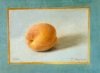
He is said to have painted the "Peach", on the spot, as a thank you. Ms. Potter adds, " I made note of a small-unframed oil on cardboard measuring about 6 x 9 inches. The still life of a peach had a painted green border of one or two inches separated by a gilt line. The piece was signed and dated 1922. According to a notation on the reverse, it was a gift to Lola Eldriedge for kindnesses paid to the artist." - Notes, Elisabeth Walton Potter, 1979.
So bad was his afliction that Gegoux placed a funnel in a hole in the wall, which allowed him to breathe fresh outside air through the funnel without getting up from bed. During his worst times, Mattie Eldriedge and Mary Eldriedge brought him milk, bread, and firewood.
He is said to have painted the "Peach", on the spot, as a thank you. Ms. Potter adds, " I made note of a small-unframed oil on cardboard measuring about 6 x 9 inches. The still life of a peach had a painted green border of one or two inches separated by a gilt line. The piece was signed and dated 1922. According to a notation on the reverse, it was a gift to Lola Eldriedge for kindnesses paid to the artist." - Notes, Elisabeth Walton Potter, 1979.
(20) At the time of my interview with her, I noted that Mrs. Eldriedge had a son living in Salem. She had asked Gegoux to do a painting for him of a forest fire scene depicted on a calendar. This painting is still in the family as of today. - Notes, Elisabeth Walton Potter, 1979.
(21) The oldest museum in Los Angeles, the Southwest Museum was founded in 1907 by Charles Fletcher Lummis and members of the Southwest Society, a branch of the Archaeological Institute of America. The museum was located in downtown Los Angeles until 1914, when the doors of the present building opened. Designed by the firm of Sumner Hunt and Silas Burns, the Southwest Museum is now a Los Angeles historic landmark.
(22) Sunrise at Castle Rock. Painted on the beach north of Santa Monica, California. Oil on canvas, measuring 14 inches by 25 inches, signed and dated in 1925. Castle Rock was an early tourist attraction on the beach north of Santa Monica, California, mid-way between Sunset and Topanga Boulevard. Regarded as a traffic hazard, the natural landmark was leveled by dynamite. Today, only the smaller rocks remain. "Santa Monica Bay", by Fred E. Basten 1974.
